
Horror Through the Ages
when to be frightened

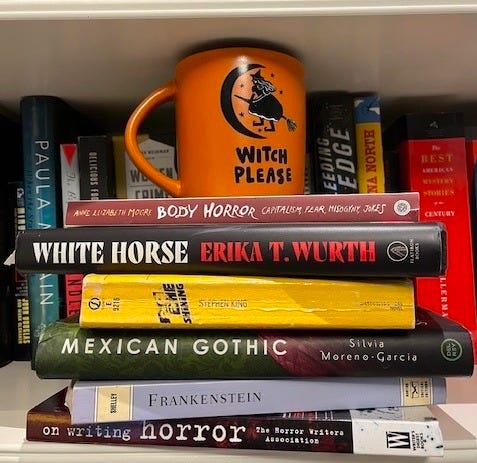
I’ve been a fan of horror movies for much of my adult life. Like most Horror fans, I have some subgenres I avoid (but am neutral on their existence). Horror can polarize people. But what Horror often does best is tap into the zeitgeist of whatever is frightening in a given era.
I’m a Gen Xer so I’m going to focus on the iconic horror of that generation—the movies you watched in friends’ basements, movies that made parents register mild concern. They created tropes that endured for decades, dislodged from their era: Jason’s hockey mask and Michael Myers’ mechanic’s suit which make a Halloween appearance on my kid’s bus route inspiring a dozen second graders to rank their courage based on whether they could look out the window or not—despite having never seen the films. We live with the images of A Nightmare on Elm Street, Halloween, Friday the 13th, Scream (which satirizes them all).
As a teenager, I read a lot of Stephen King and am still a fan. I didn’t watch the 1990 It miniseries, but Pennywise has migrated into my adult life, scaring my child badly enough he brings it up apropos of nothing, which is unnerving in its own way. He saw Pennywise once in a Target on an Entertainment Weekly cover for Stephen King in 2019. Now, he’ll ask me about it a couple times a year. “What about that clown?”
Horror endures, but on a granular level it’s received differently depending on the cultural climate. The Stand would feel different during the pandemic, of course. But maybe that’s also because on an individual level we read the drama of horror through the lens of our age. I’ve been reading a lot of closed-circle mysteries, so I decided to re-watch Kubrick’s The Shining this Halloween. I was surprised how different it felt after a ten year respite.
King famously didn’t like Kubrick’s version, especially Wendy. I see why. But I view Kubrick’s film as a separate piece, with different themes. It’s the parenting aspects that jump out at me now.
When I watched The Shining in my pre-parenting life, I was not that frightened by it. I was disturbed by the uncanny and grotesque images in the same way I felt unmoored by Suspiria and Midsommar (two more favorites). In my twenties, Danny was never really in peril, because he always got away using the shining. Instead, the supernatural forces of the hotel resonated with all I feared about the barriers between life and death. The hotel scared me the most.
Now, I’m worried about the kid. This shifted my focus to Wendy, played by Shelley Duvall who was initially panned for her performance. I can’t overstate my immense compassion for her character, except to say most of her scenes with Danny slightly nauseate me with fear for them both.
Initially, Duvall was often reviewed as playing Wendy too mawkishly frightened. Both she and Nicholson’s performances feel emotionally off, which is disquieting, and maybe the point. But Duvall seems to be playing a traumatized wife in the throes of domestic abuse. For me, Wendy often appears complex, her mask of fear or calm (whatever her performance demands) barely covers a range of visceral emotions just below the surface.
Wendy must alter her narrative to fit her husband’s views if she wants to avoid strife and preserve the family unit. For better or worse (in this case much worse) she’s hitched her wagon to Jack, and for most of the film, we see her wearing two masks: one to calm Danny’s fears and one to calm Jack’s rage.
The scene where Danny is channeling Tony for his own safety has a slow unwinding horror of familial implosion that reflects the genre at its best. What is more horrifying than a child in peril? We experience most of this through Wendy, sitting on the edge of the bed in a common parental move toward providing comfort. She knows that the family unit has disintegrated, but can’t bring herself to see the reality of the situation. Maintaining her parental mask, she keeps telling Danny it’s okay, when of course it’s not.
Wendy’s awakening happens in earnest at the typewriter in the great room when she realizes their entire reason for being at the Overlook is now an illusion. As she reads, “All Work and No Play Make Jack a Dull Boy” in block indents, quotations, with fluctuating margins, she sees Jack has given over to something darker. Her expression wavers between disbelief, terror, sadness, and hopelessness. It isn’t until she locks Jack in the storeroom that she finds agency and liberates herself—regardless of what happens next. It’s enough that she says, “I’m going now. I’m going to try to get Danny down [...] in the Snowcat.” She’s essentially lost her mask, and is following her own desire to save her son. That’s a heroine overcoming evil.
I’d always read Danny as a hero realizing his power. With age, there are multiple heroes, and I’m here for it.

Now I want to watch The Shining again. LOL! Great post!